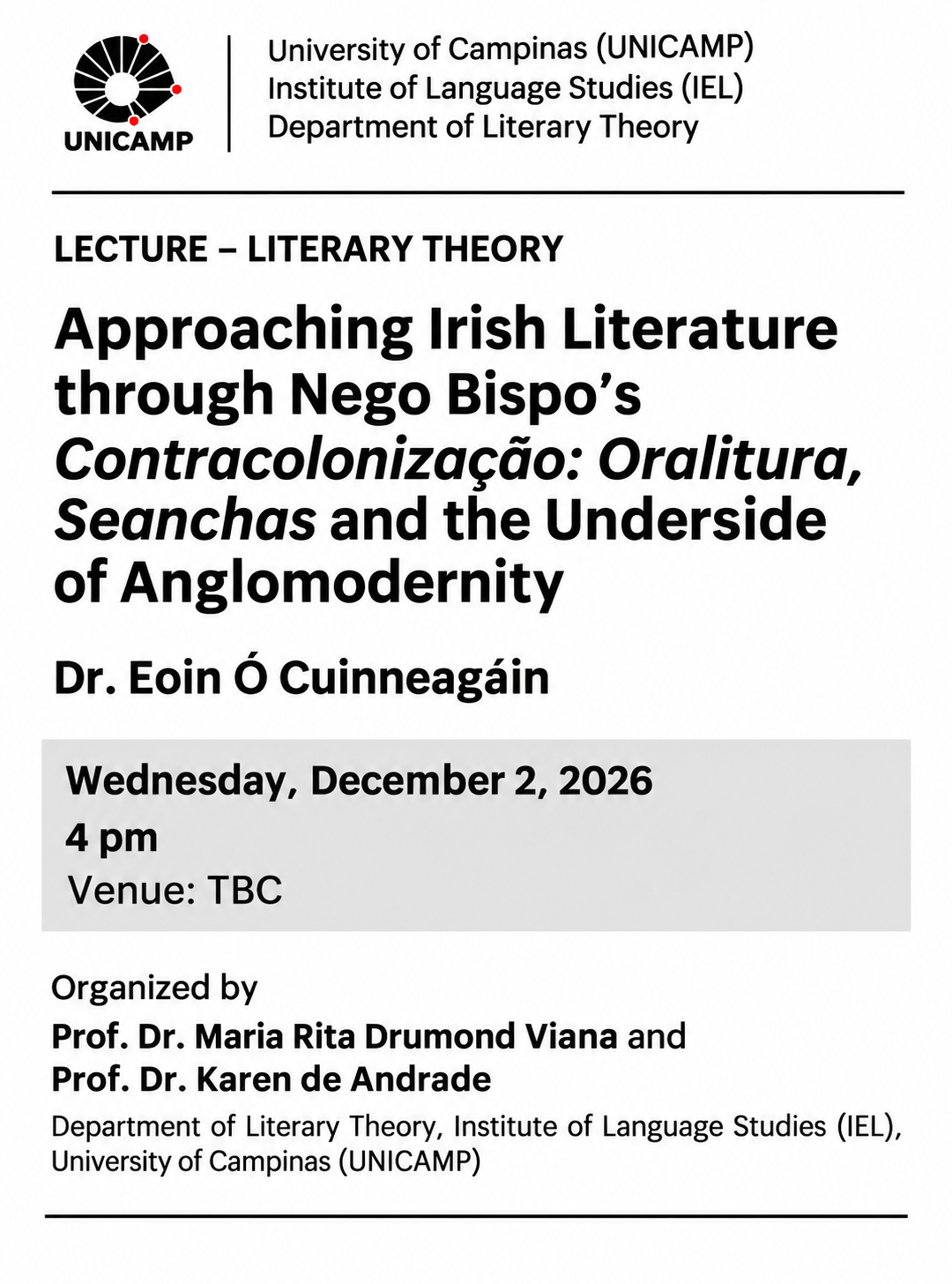
The lecture approaches Irish literature through Nego Bispo’s contracolonização [counter-colonization] and guerra das denominações [war of denominations], reading the category of “Irish literature” through the devaluation, folklorization and institutional deconstitution of litríocht na Gaeilge. Drawing on Gearóid Denvir, Alan Titley, Máirín Nic Eoin, Lillis Ó Laoire, Gerry Smyth, and Santiago Castro-Gómez, it traces how English became the unmarked literary norm while Gaelic oral and manuscript practices were decentred and progressively renamed as folklore, folk song, superstition, mythology and tradition.
The lecture then places seanchas in dialogue with the genealogy of oralitura developed by Pio Zirimu, Ernst Mirville, Édouard Glissant, Maximilien Laroche, Jean Bernabé, Patrick Chamoiseau, Raphaël Confiant, Yoro Fall, Ngũgĩ wa Thiong’o and Leda Maria Martins. Bispo’s writing on mestras e mestres de ofício [masters of craft], the “desmantelamento e substituição compulsória” [“dismantling and compulsory replacement”] of orally transmitted knowledge, his poem “Cabelos,” and his insistence that “Mesmo que queimem a escrita, / Não queimarão a oralidade” [“Even if they burn the written word, / They will not burn the oral tradition”] provide the relational, countercolonial frame through which Gaelic literary praxis is read as an autopoietic intellectual world that continues to generate its own theories of language, knowledge and literature.